The main rules
| Rule | What it covers |
|---|---|
| Health and Safety (Safety Signs and Signals) Regulations 1996 | Employers must provide and maintain safety signs where risks remain after other controls, using the prescribed shapes and colours. |
| Regulatory Reform (Fire Safety) Order 2005 (England and Wales) | The responsible person must carry out a fire risk assessment, and emergency routes and exits must be indicated by signs. |
| Fire (Scotland) Act 2005 and Fire Safety (Scotland) Regulations 2006 | The equivalent duties in Scotland. |
| Fire Safety Regulations (Northern Ireland) 2010 | The equivalent duties in Northern Ireland. |
| Equality Act 2010 | Service providers must make reasonable adjustments, which includes signage that disabled people can find, read and understand. |
The standards most signs follow
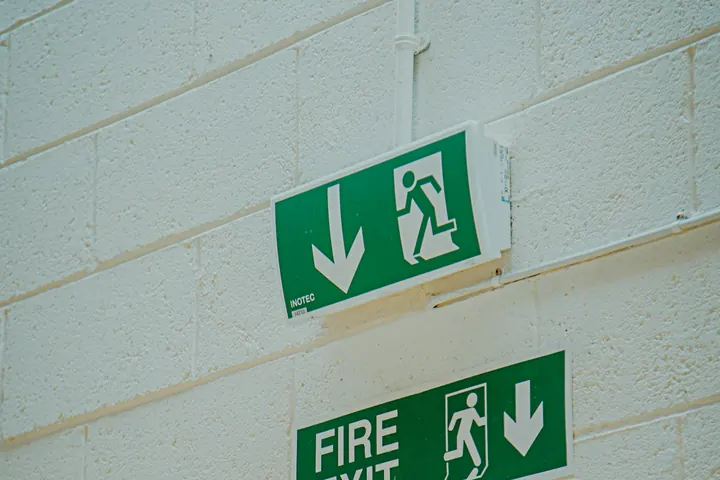
- BS EN ISO 7010: the registered pictograms for safety signs, including the running-man fire exit sign.
- BS 5499-4: code of practice for escape route signing.
- BS 5499-10: guidance on selecting and using safety signs.
- BS 5266-1: emergency lighting, including illuminated exit signs.
- BS 8300: design of an accessible built environment, including guidance on signage, contrast and wayfinding.
Standards are not law in themselves, but following them is the usual way to show the legal duties have been met.
Safety sign shapes and colours
| Sign | Shape and colour | Example |
|---|---|---|
| Prohibition | Red circle with a diagonal bar | No smoking |
| Warning | Yellow triangle with a black border | Slippery floor |
| Mandatory | Blue circle | Wear eye protection |
| Safe condition | Green rectangle or square | Fire exit, first aid |
| Fire equipment | Red rectangle or square | Fire extinguisher, fire alarm call point |
What to check in an audit
- Escape routes are signed continuously from every point to a final exit.
- Signs along a route use one consistent style. Mixing old and new fire exit styles on one route is confusing.
- Fire equipment and fire alarm call points are signed where they aren't obvious.
- Signs are visible, unobstructed, readable at the distance they'll be seen from, and lit where the escape route needs it.
- Damaged, faded or missing signs are recorded and fixed.
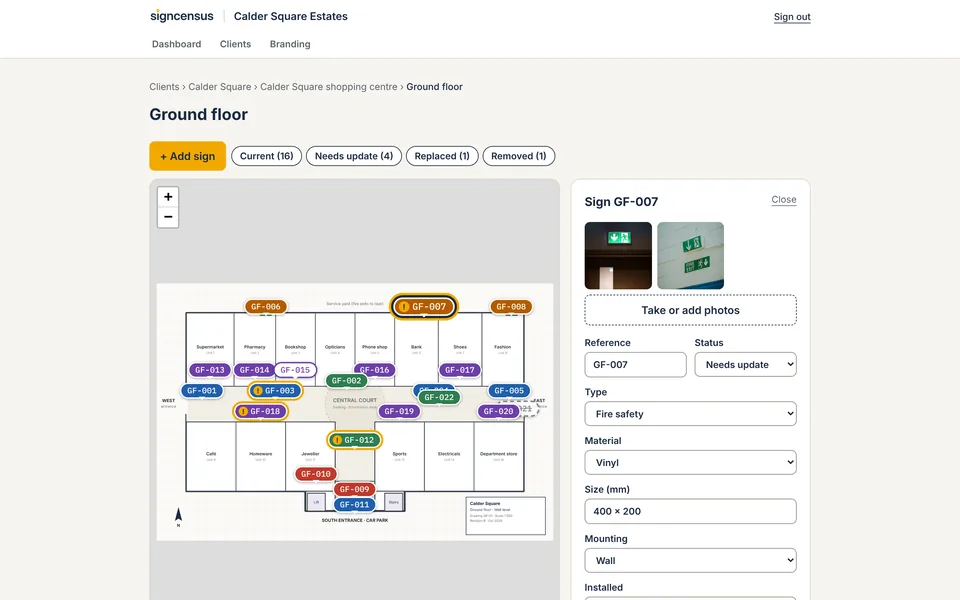
Record safety signs in the same signage audit as everything else, with their own sign type, so they can be filtered and reported on separately.
This is general information, not legal advice. The site's responsible person and fire risk assessor decide what each building needs.
Questions
- Who is responsible for fire safety signs?
- The responsible person for the premises, usually the employer, owner or occupier. They must carry out a fire risk assessment, and the signage it calls for must be provided and maintained.
- Do old-style fire exit signs need replacing?
- Current UK guidance favours the BS EN ISO 7010 pictogram. The key point is that each escape route uses one consistent style, so mixed or confusing signs should be replaced. Ask your fire risk assessor about your building.
- Are safety signs a legal requirement?
- Yes, where a risk remains after other controls. The Health and Safety (Safety Signs and Signals) Regulations 1996 require employers to provide them, and fire safety law requires emergency routes and exits to be signed.