

Why organisations audit their signs
Most estates have no reliable list of their signs. Signs are added by different contractors over many years, records live in old drawings and spreadsheets, and nobody is sure what is on the wall today. An audit fixes that. Common reasons to commission one:
- A rebrand or name change. You need to know how many signs carry the old brand, at which sites, and what each one is made of, before anyone can quote.
- Repairs and maintenance. Damaged, faded, unlit or missing signs need to be found, prioritised and fixed.
- Safety and compliance. Fire exit, fire equipment and safety signs need to be present, correct and visible. See UK safety signage rules.
- Wayfinding. Visitors get lost when directional signs are missing, out of date or contradict each other.
- Acquisitions and new contracts. A sign company taking over an estate, or an owner buying a site, needs a baseline.
What to record for each sign
Agree the fields before anyone goes on site, so every surveyor records the same things. A good minimum:
| Field | Example | Why it matters |
|---|---|---|
| Reference number | SGN-0142 | A unique ID to quote, order and install against |
| Location | Pin on the ground floor plan, plus GPS | So anyone can find the sign again |
| Sign type | Fascia, totem, projecting, wayfinding, safety | Groups signs for pricing and manufacture |
| Message or content | “Fire exit →” | Shows what needs changing |
| Size and material | 1200 × 400 mm, aluminium composite | Needed to quote replacements |
| Illumination | Internally lit, LED | Affects cost, power and consent |
| Fixing | Wall fixed, 4 stand-off fixings | Affects installation time and access |
| Condition | Good, faded, damaged, missing | Drives the action list |
| Action | Keep, repair, replace, remove | Turns the audit into a plan |
| Photos | Front, close-up, context | Evidence, and saves a second visit |
The sign schedule guide explains each field and includes a template.
How to run a signage audit, step by step
- Agree the scope. Which sites, which floors, inside and outside, and which sign types are in scope (for example, do you include temporary posters or statutory notices?).
- Gather plans. Get a floor plan or site plan for each area. If there isn't one, a photographed fire plan, a sketch or an aerial image is enough to pin to.
- Set up the fields and sign types so every surveyor records the same thing.
- Walk the site in a fixed route, for example clockwise from the main entrance, floor by floor, so nothing is missed.
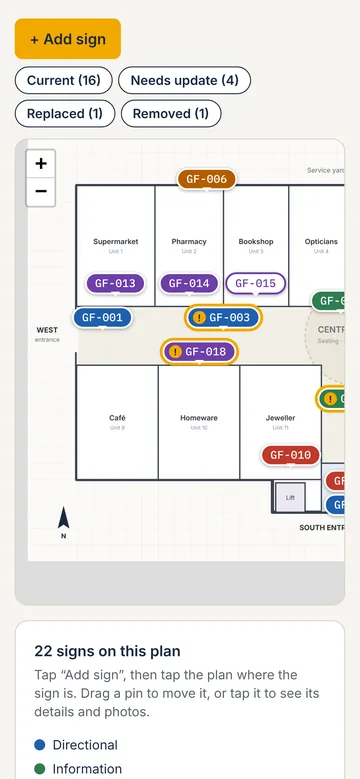
- Pin, photograph and describe each sign as you reach it. Number signs in the order you find them.
- Mark the condition and action while you're standing in front of the sign, not from photos later.
- Check the gaps. Walk the escape routes again and look for places a sign should be but isn't.
- Review and share. Filter by condition and action, check the totals, and produce the schedule for the client or the team.
The survey checklist covers what to take on site and what to check at each sign.
What you should end up with
- A plan for each area with every sign numbered on it.
- A sign schedule: one row per sign with its details, condition and action.
- Photos of every sign, linked to its row.
- Totals by sign type and action, which are what a quote or budget is built from.
Treat the audit as the start of a record, not a one-off report. If the schedule is updated whenever a sign is installed, repaired or removed, the next audit is a check rather than a full survey.
Doing it with Signcensus
Signcensus is built for exactly this job. Upload each plan, walk the site with your phone, tap the plan to drop a numbered pin, take photos with the phone camera, and set the sign type, status and your own custom fields. Every change is logged, and you can filter the whole site by status when you get back to the office. See how it works or start a free trial.
Questions
- How long does a signage audit take?
- It depends on the number of signs, how spread out they are and how much detail you record. Recording each sign on a phone while you stand in front of it, rather than writing it up from photos afterwards, removes most of the office time.
- Who should carry out a signage audit?
- Sign companies often audit for their clients as the first stage of a rebrand or maintenance contract. Estate and facilities teams also audit their own buildings. Checks of fire safety signage should feed into the site's fire risk assessment, which is the responsible person's duty.
- What is the difference between a signage audit and a signage survey?
- The terms are often used interchangeably. A survey usually means the site visit and the measurements taken; an audit usually means the resulting record and the judgement on what needs to change.
- How often should signage be audited?
- There is no single legal frequency for signs in general. Many estates do a full audit before a rebrand or new contract and then keep the record up to date as work is done. Safety signs should be checked as part of the regular fire risk assessment review.